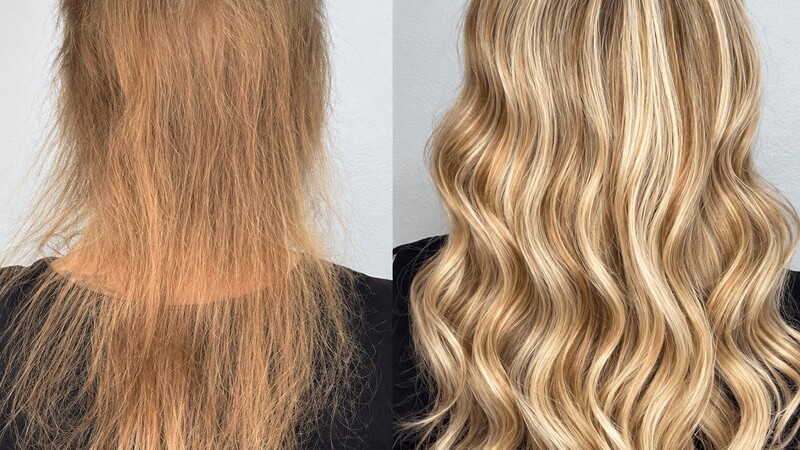
Bleached hair may require a different straightening plan because chemical lightening alters the hair’s internal structure, potentially making it more vulnerable to additional processing and heat. Japanese hair straightening involves chemical restructuring and thermal treatment, so previously bleached strands must be carefully evaluated before determining whether the service is appropriate.
For clients in Scottsdale, AZ, who want permanently straighter hair after receiving highlights or blonde coloring, the decision involves more than selecting a straightening method. Understanding previous processing, existing damage, and treatment compatibility helps establish realistic expectations while protecting hair integrity.
How Does Bleaching Change the Structure of Hair?
Hair consists primarily of keratin proteins arranged within a complex internal structure. These proteins contain chemical bonds that contribute to the hair’s strength, elasticity, and natural shape.
Bleaching uses oxidizing agents to reduce pigment within the hair fiber. However, the process can also affect the surrounding proteins and structural bonds.
The extent of these changes depends on the hair’s original condition, previous treatments, product formulation, and processing history.
Changes to Keratin Bonds
Disulfide bonds contribute to the stability of keratin structures within hair.
Chemical bleaching can oxidize sulfur-containing components of these proteins, altering bonds that help maintain structural integrity.
These changes may reduce the hair’s ability to tolerate additional chemical and mechanical stress.
Previously bleached strands can therefore respond differently to straightening products than untreated hair.
Increased Porosity and Fragility
Bleaching may also alter the protective cuticle surrounding the hair fiber.
When the cuticle becomes compromised, hair may absorb and release moisture differently and experience increased friction or breakage.
Some sections may remain relatively strong, while repeatedly lightened areas become more fragile.
This variation is particularly important when planning services involving chemical restructuring and heat.
How Does Japanese Hair Straightening Work?
Japanese hair straightening is a permanent chemical restructuring service designed to create a straighter hair texture.
Many traditional systems use a reducing solution to alter disulfide bonds, followed by controlled thermal straightening and a neutralizing process.
The chemical system allows the hair to be reshaped, while the subsequent steps help establish the new configuration.
Because the process changes the hair’s structure, it requires careful assessment and professional application.
Why Is Chemical Compatibility Important?
Different chemical services affect hair through different mechanisms.
Bleaching uses oxidation to lighten pigment, while traditional Japanese straightening systems generally involve reduction, thermal reshaping, and oxidation during neutralization.
Although these processes serve different purposes, both can influence the hair’s structural integrity.
When previously bleached hair undergoes additional chemical restructuring, existing damage may affect its response.
This does not mean every previously colored strand is unsuitable, but significant bleaching history can restrict treatment options.
Why Does Heat Add Another Consideration?
Thermal straightening involves controlled heat to reshape hair after chemical processing.
Previously bleached strands may have reduced resistance to additional thermal stress.
If their structure is already compromised, excessive heat or inappropriate processing can increase the likelihood of breakage.
Professional assessment helps determine whether the hair can reasonably tolerate the proposed procedure.
Can Previously Bleached Hair Undergo Japanese Straightening?
Some previously lightened hair may be considered for straightening following a detailed professional assessment, but suitability cannot be assumed.
The amount of bleaching, current hair condition, product compatibility, and intended straightening system all influence the decision.
Certain manufacturers restrict or prohibit application to bleached hair, making their specific instructions essential.
Lightly Highlighted Hair
Someone with a limited number of highlights may have substantial areas of untreated hair.
However, the highlighted sections still require individual consideration.
A stylist must determine whether the chemical system can be applied without compromising previously processed strands.
A small amount of highlighting does not automatically establish compatibility.
Extensively Bleached Hair
Hair that has undergone repeated lightening may contain significant structural damage.
These strands can be more vulnerable to additional chemical processing, particularly when the hair has been lightened to very pale blonde.
In such circumstances, permanent straightening may be inappropriate.
A professional may recommend postponing the service, considering another approach, or avoiding chemical straightening altogether.
Why Can Bleached Hair Require Different Treatment Zones?
Different areas of the hair may have different levels of strength, porosity, and processing history.
For example, natural regrowth might tolerate certain treatments differently from previously bleached ends.
This does not automatically mean separate chemical formulations can safely accommodate every section.
Untreated Regrowth
New growth generally has not experienced the same chemical processing as older lengths.
Its structural condition may therefore differ from previously lightened hair.
A professional must determine whether a regrowth-focused service is possible while respecting manufacturer instructions and preventing unwanted chemical overlap.
Previously Lightened Midlengths
The midlengths may contain older highlights or artificial color.
These areas require evaluation because their appearance does not necessarily reveal the full extent of previous chemical processing.
Additional straightening chemicals may be unsuitable if the strands have already experienced significant structural changes.
Fragile Ends
Hair ends are often older and may have undergone more coloring, heat exposure, and mechanical wear.
When these sections are weakened, further processing can increase the risk of breakage.
An appropriate straightening plan must account for these differences instead of treating the entire head as chemically uniform.
How Do Professionals Evaluate Straightening Suitability?
A professional consultation involves reviewing previous treatments, examining hair condition, and considering the requirements of the intended straightening system.
Clients researching japanese thermal hair straightening should understand that permanent texture changes require careful evaluation, particularly when bleaching is involved.
The assessment helps establish whether the proposed service is compatible with the hair’s existing condition.
Reviewing Chemical History
A stylist may ask about previous highlights, full-head bleaching, permanent coloring, straightening, and other chemical treatments.
Even older services can remain relevant because the affected hair continues growing until it is cut.
Knowing the processing history helps identify areas that may be more vulnerable to additional treatment.
Assessing Hair Strength
Professional evaluation considers visible breakage, strand integrity, elasticity, and differences between processed sections.
Hair that appears glossy or smooth is not necessarily structurally strong.
Conditioning products can improve manageability and appearance without reversing every chemical change caused by bleaching.
This distinction is important when evaluating whether further processing is appropriate.
Considering Strand Testing
Where permitted by the product manufacturer, strand testing may help assess how selected hair responds to a proposed treatment.
However, a successful strand test does not guarantee that the entire head will respond identically.
Hair condition can vary considerably between sections.
Professional judgment and product compatibility requirements remain essential.
When Should Straightening Be Modified, Postponed, or Avoided?
Not every client with previously bleached hair is an appropriate candidate for permanent chemical straightening.
A responsible recommendation considers the current hair condition and the limitations of the selected system.
When Treatment Modification May Be Considered
If certain sections have different processing histories, a stylist may evaluate whether the proposed service can be limited or adjusted.
However, modification is only appropriate when supported by the manufacturer’s instructions and the condition of the hair.
Reducing processing intensity does not automatically make an incompatible treatment safe.
When Postponement May Be Appropriate
A stylist may recommend postponing straightening when the hair shows significant dryness, breakage, or inconsistent structural condition.
Additional assessment or a revised styling plan may be necessary.
Waiting alone does not restore irreversibly damaged bonds or guarantee future eligibility.
When Permanent Straightening Should Be Avoided
Chemical straightening should not proceed when the hair cannot safely tolerate the process or the product manufacturer identifies a contraindication.
Severely compromised bleached hair may be unsuitable regardless of the client’s desired result.
Avoiding the service can be the most appropriate professional decision.
Are Other Smoothing Options Automatically Safer?
Not necessarily.
Japanese straightening, keratin-based smoothing, and other texture services involve different ingredients, application requirements, and potential risks.
A treatment described as gentler does not automatically establish compatibility with damaged or bleached hair.
Some smoothing systems involve substantial heat, while others contain ingredients requiring additional safety considerations.
The appropriate option depends on the actual product, existing hair condition, and desired outcome.
A professional evaluation should distinguish temporary manageability goals from permanent structural changes.
Why Are Realistic Expectations Important?
Clients may want permanently straight hair while maintaining a very light blonde shade.
However, combining extensive bleaching with permanent chemical restructuring may be incompatible with the condition of their hair.
A consultation helps clarify which goals can reasonably be pursued without unnecessary processing.
Sometimes, preserving the current color may take priority over changing texture.
In other situations, a client may reconsider the desired result after understanding the limitations.
Neither outcome represents an unsuccessful consultation.
Choosing an Appropriate Straightening Plan
Bleached hair requires special consideration because previous lightening can alter keratin proteins, increase porosity, and reduce structural strength.
Japanese permanent hair straightening introduces further chemical and thermal changes that may be unsuitable for compromised strands.
For Scottsdale clients considering a Japanese straightening treatment, professional assessment helps determine whether the service is appropriate, requires modification, or should be avoided.
The most responsible decision balances appearance goals with chemical compatibility and the existing condition of the hair.
About Bravo Salon
At 10614 N 71st Place in Scottsdale, Arizona, Bravo Salon provides professional coloring, Japanese thermal straightening, and related hair services. Their owner, Alicia Shannon Bravo, is identified by the salon as a certified Japanese Liscio and Yuko straightening specialist, reflecting their focus on professional texture services. For appointment inquiries, call (480) 951-8076 or view their salon location on Google Maps.