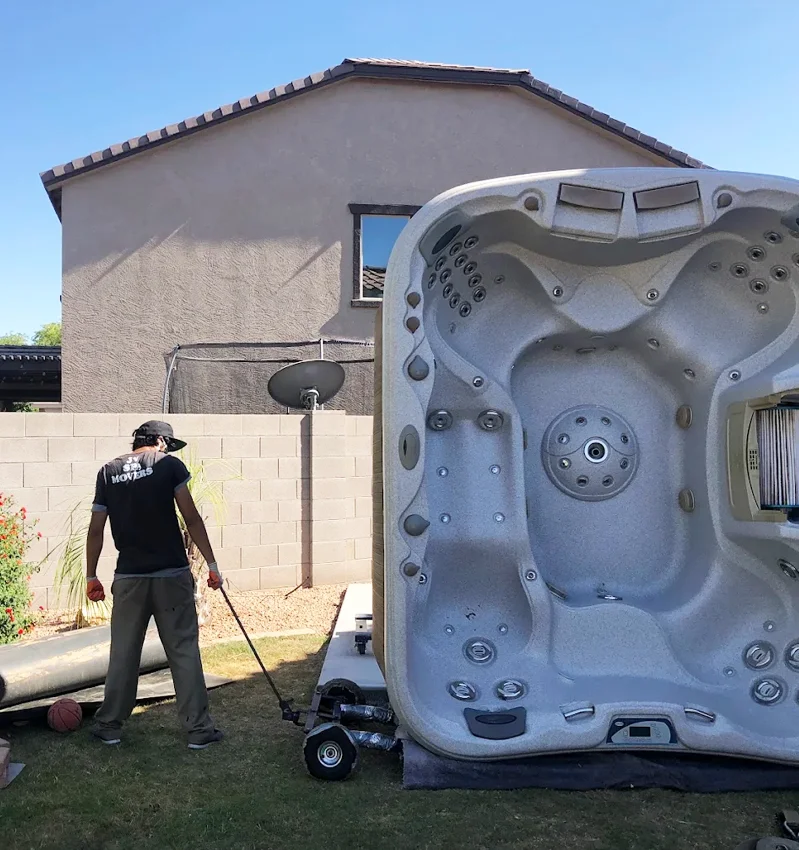
Moving a swim spa generally requires more detailed planning than relocating a standard hot tub because the unit is typically longer, occupies a larger footprint, and can require different handling and access considerations. Although both moves involve careful preparation, transportation, and placement, the route and equipment plan should be based on the actual unit rather than assuming every spa can be moved the same way.
For property owners in Tucson, understanding these differences is especially useful before scheduling a relocation. Gates, side yards, landscaping, patios, elevation changes, and the final destination can influence whether a straightforward hot tub move becomes a more involved swim spa project.
What Is the Main Difference Between Moving a Swim Spa and a Hot Tub?
The primary difference is the physical footprint of the unit.
A conventional hot tub is generally designed around seated soaking and hydrotherapy, while a swim spa provides an elongated water area for swimming or exercise in addition to relaxation features. That longer design changes how the unit fits through a property.
Even when two units can be handled with similar moving principles, the available space needed to maneuver them may be different.
For spa movers, the important questions include:
- How long and wide is the unit?
- How much room surrounds its current location?
- Can it turn through the planned route?
- Are gates and access areas wide enough?
- What surface will the unit cross?
- Is the destination prepared?
- Is there adequate working space at both ends?
The answers determine the moving plan much more reliably than simply labeling the unit a hot tub or swim spa.
Why Does the Longer Shape of a Swim Spa Matter?
Length can become especially important when a move includes corners.
Imagine carrying a long object through an L-shaped hallway. It might fit through both sections individually but still be unable to make the turn between them.
A similar issue can arise outdoors.
A swim spa might fit through a wide gate but encounter difficulty immediately afterward if a block wall, pool fence, outdoor kitchen, or landscaping feature restricts the turning radius.
That is why measuring only the narrowest opening is not enough.
The complete route needs to be evaluated as one connected pathway.
How Do Spa Movers Evaluate the Access Route?
Professional planning typically starts at the unit’s current position and follows the entire route to the loading area.
The route may include:
- Patio surfaces
- Gravel
- Artificial turf
- Side yards
- Gates
- Retaining walls
- Steps
- Sloped areas
- Pool decks
- Landscape borders
- Driveways
With a standard hot tub, some tight turns may still provide enough space to reposition the unit gradually. A longer swim spa can require more open space to make the same directional change.
Homeowners should therefore provide measurements and clear photographs of more than just the gate.
Photos showing the approach to the gate, the area immediately beyond it, and any corners along the route can provide much more useful planning information.
Does a Swim Spa Require Different Moving Equipment?
The appropriate moving equipment depends on the specific unit and property conditions.
Size, construction, condition, access, travel route, and placement requirements can all affect what is needed. A larger footprint may require a different equipment setup or moving strategy than a smaller spa.
This is one reason professional movers should know the unit’s dimensions before arriving.
A qualified Swim Spa Mover can evaluate the unit along with the pickup and destination conditions instead of treating the move as a standard one-size-fits-all relocation.
The goal is controlled handling from the starting position through transportation and final placement.
Why Is Turning Space So Important?
Turning space is easy to underestimate because most people naturally focus on width.
A gate might appear to provide enough clearance based on a tape measurement. However, the unit may need to rotate immediately before or after passing through the opening.
Longer units need additional consideration because one end can swing toward a wall, fence, structure, or landscape feature while the other end is being repositioned.
This can become particularly important around:
- Block walls
- Pool areas
- Patio columns
- Outdoor kitchens
- Pergolas
- Retaining walls
- Storage structures
- Air-conditioning equipment
A route should therefore be evaluated for both straight-line clearance and directional changes.
How Does the Starting Location Affect the Move?
A swim spa positioned in an open backyard creates a different moving situation from one surrounded by permanent structures.
For example, a unit may have been placed before a fence, patio cover, outdoor kitchen, or landscaping project was completed. Years later, those additions can change the available route considerably.
The same principle applies to a standard hot tub.
The route available today matters more than the access conditions that existed when the unit originally arrived.
Before scheduling a spa moving service, homeowners should look at the current property layout and identify anything that could restrict movement.
What Should Be Checked at the Destination?
The destination deserves as much attention as the pickup location.
Moving the unit successfully across the property is only part of the job. There also needs to be a practical route into the new location and enough space for controlled placement.
Property owners should confirm:
The Access Path
The path from the unloading area to the destination should be clear and accessible.
The Final Position
The intended placement should be established before the unit arrives rather than decided while the move is underway.
Surrounding Clearance
Nearby walls, fencing, structures, landscaping, and other permanent features should be considered.
Site Readiness
Any construction or site preparation that affects moving access should be completed or coordinated before the scheduled relocation.
Questions involving electrical connections, structural capacity, or specialized site construction should be handled by the appropriate qualified trade professional.
Does Distance Make a Swim Spa Move More Difficult?
Distance is only one factor.
A relocation across town can involve a complicated pickup route but an easy destination. A move within the same property may involve only a short physical distance but still require careful planning because of gates, slopes, walls, or landscaping.
For hot tub movers and spa-moving professionals, access conditions frequently determine how the physical handling portion of the job must be planned.
This means homeowners should avoid assuming that a move will be simple merely because the new placement area is nearby.
Can a Swim Spa Be Repositioned on the Same Property?
A swim spa may sometimes need to be moved without leaving the property.
Possible reasons include backyard remodeling, changes to landscaping, construction work, or repositioning the unit to another prepared area.
Same-property moves still require route planning.
A unit might need to cross only part of the yard, but that route could contain gravel, hardscaping, landscaping borders, or elevation changes.
The moving plan should reflect the actual path rather than the mileage involved.
What Information Should Be Provided Before Scheduling?
Accurate information can make the planning process much more efficient.
Homeowners should be prepared to provide:
- Unit dimensions
- Photos of the spa
- Pickup address
- Destination address
- Photos of both locations
- Gate measurements
- Side-yard measurements
- Surface information
- Known steps or elevation changes
- Nearby structures
- Final placement details
If the manufacturer and model are known, that information may also help identify relevant specifications.
Current photographs are especially useful if the backyard has changed since the spa was originally placed.
How Should Homeowners Measure a Moving Route?
Start with the unit itself.
Record its approximate length, width, and height. Then measure the major openings along the proposed route.
Do not stop at the gate.
Check the space approaching the gate, the area immediately beyond it, and any corner where the unit will need to change direction.
Also look upward.
Tree branches, patio covers, pergolas, roof overhangs, lighting, and other features may affect available clearance depending on how the unit needs to be maneuvered.
A simple sketch of the route can also help identify where the tightest points occur.
Are Swim Spa Moves Always More Complicated?
Not necessarily.
A large swim spa with direct driveway access and an open destination may present fewer access challenges than a smaller hot tub located behind a narrow gate with several tight turns.
The type of unit matters, but property layout matters too.
That is why spa movers evaluate the individual move rather than assuming difficulty based only on the spa category.
A good moving assessment considers the unit and property together.
What Can Homeowners Do Before Moving Day?
Preparation can reduce avoidable obstacles.
Homeowners can:
- Remove patio furniture from the route.
- Move planters, hoses, tools, and decorations.
- Make sure gates can open fully.
- Keep parked vehicles away from required access.
- Inform movers about construction activity.
- Provide updated photographs if the property changes.
- Confirm the destination remains accessible.
If contractors are working at either property, coordination can be especially important.
A route that was open when the move was scheduled can become blocked by building materials, equipment, temporary fencing, or other project activity.
Why Should Swim Spa Moving Be Planned Separately?
It may be tempting to think of a swim spa as simply a larger hot tub. From a moving perspective, however, the additional length can influence turning room, access, positioning, and equipment planning enough that the unit deserves its own assessment.
The same professional principles still apply: evaluate the unit, inspect the route, prepare both locations, move it in a controlled way, and place it at the intended destination.
What changes is how those principles are applied to the specific dimensions and property conditions.
What Should Tucson Property Owners Consider?
Tucson properties can vary substantially in backyard design.
One property may have direct driveway access, while another may require movement through a side yard between walls. Landscaping, pools, gravel areas, patios, and elevation changes can also affect the route.
The useful question is therefore not simply, “Can this swim spa be moved?”
A better question is, “What does this particular unit need to travel from this exact starting point to this exact destination?”
Answering that question before moving day helps establish a realistic plan.
Plan the Move Around the Unit and the Property
Moving a swim spa and moving a standard hot tub rely on many of the same basic principles, but the units should not automatically be treated as interchangeable. A swim spa’s longer footprint can affect turning clearance, equipment planning, route selection, and final positioning.
Before scheduling a relocation, property owners should document the unit dimensions, inspect the complete route, measure restrictive areas, and confirm that the destination is ready. Those steps help professional movers evaluate the move based on actual conditions instead of assumptions.
For homeowners considering a swim spa or hot tub relocation in Tucson, getting the route reviewed in advance can make it easier to identify access concerns before moving day.
About JV Spa Movers
JV Spa Movers is based in Glendale, Arizona, and has provided professional spa and hot tub moving services since 2019, including relocation of swim spas, hot tubs, jacuzzis, and saunas using specialized moving equipment. They serve residential and commercial customers throughout Arizona; call (623) 522-3188 for service information or find their office on Google Maps.