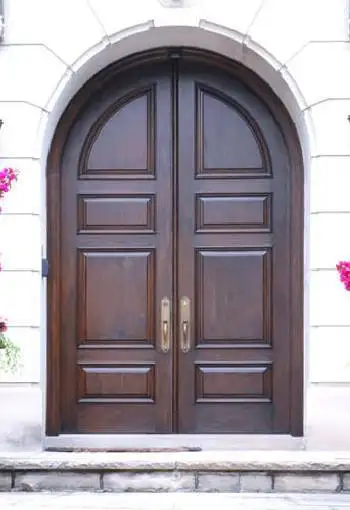
Yes, a Dutch door can work as an entrance between a home and courtyard when its construction, hardware, weather sealing, and opening configuration are appropriate for exterior use. Its divided design allows the upper section to open independently while the lower section remains closed, creating a flexible connection between indoor and outdoor spaces.
Unlike conventional home entry doors, Dutch doors offer more than a fully open or closed position. Homeowners can open the upper panel for conversation, visibility, or occasional airflow without opening the entire entrance.
For homes in Scottsdale, AZ, courtyard design, sunlight exposure, privacy, and seasonal weather conditions can influence whether this arrangement is practical.
Understanding how a Dutch door functions within a courtyard entrance helps homeowners evaluate its advantages and limitations before selecting materials or planning an installation.
What Makes a Dutch Door Suitable for a Courtyard Entrance?
A Dutch door has two horizontal sections that can operate independently. Compatible connecting hardware also allows the sections to function together as a conventional door when secured.
This arrangement can be useful for a courtyard entrance because it gives homeowners greater control over how the opening is used.
For example, someone preparing a meal near a courtyard-facing doorway may want to speak with a family member outside without opening the entire door.
Similarly, a homeowner enjoying a shaded courtyard may prefer to keep the lower panel closed while opening the upper section during comfortable weather.
However, the lower section should not automatically be treated as a security barrier or reliable method of containing children or pets.
The suitability of the arrangement depends on the door’s construction, hardware, placement, and intended use.
How Does Courtyard Layout Affect Dutch Door Placement?
The relationship between the doorway and surrounding courtyard influences how comfortably the door operates.
A courtyard may be enclosed by walls, connected to a covered patio, or positioned beside an open walkway.
Each layout creates different considerations.
Courtyard Size and Circulation
The door should open without interfering with outdoor furniture, planters, or frequently used walking paths.
If both sections swing outward, the homeowner must consider the movement of each panel.
A narrow courtyard passage may provide insufficient clearance for a fully opened door.
Even when the upper section operates independently, it still requires an unobstructed swing area.
Doorway Position
A doorway positioned near a perpendicular wall or column may have limited space for hardware and panel movement.
The swing direction should be coordinated with the surrounding architecture.
For example, a Dutch door installed beside a courtyard seating area should not require visitors to step around the open panel whenever they enter or leave.
Changes in Floor Elevation
Interior and exterior floors may sit at different heights.
A raised courtyard landing, threshold, or step can influence how people approach the entrance.
These conditions should be evaluated alongside applicable building requirements before the door configuration is finalized.
Can Dutch Doors Improve Airflow Between Indoor and Outdoor Spaces?
Dutch doors can allow air to move through the upper opening while the lower section remains closed.
However, opening a Dutch door does not necessarily improve indoor comfort under every weather condition.
The amount and direction of airflow depend on wind, temperature differences, nearby openings, and the surrounding courtyard layout.
Airflow in Enclosed Courtyards
An enclosed courtyard may experience different airflow patterns from an open patio.
Surrounding walls can redirect wind or create sheltered areas.
Opening the upper section may allow air exchange when outdoor conditions are comfortable.
However, meaningful cross-ventilation usually requires an appropriate path for air to enter and leave the home.
Scottsdale’s Summer Conditions
During periods of extreme heat, leaving the upper section open may introduce warm outdoor air and increase the cooling demand inside the home.
For this reason, a Dutch door should not be presented as an energy-saving feature simply because its upper section opens independently.
Homeowners should consider when they expect to use the opening and whether the courtyard receives significant afternoon sunlight.
Seasonal Use
Mild mornings and evenings may provide more comfortable opportunities to use an open upper panel.
During dust, wind, or monsoon conditions, closing and securing the entire assembly may be more appropriate.
The door’s flexibility is useful when its operation reflects actual outdoor conditions.
How Does a Dutch Door Affect Privacy in a Courtyard?
Privacy depends on the height of the lower panel, the surrounding walls, and what can be seen through the upper opening.
An enclosed courtyard may offer greater separation from neighboring properties than an entrance facing a public sidewalk.
However, courtyard walls do not automatically eliminate visibility concerns.
Understanding Sightlines
A person standing outside may have a different view into the home from someone seated inside.
The location of nearby furniture and the relative floor elevations also influence visibility.
For example, a Dutch door opening directly into a living room may expose more of the interior than one connecting a kitchen to a private courtyard.
Homeowners should evaluate sightlines from both sides of the doorway.
Choosing the Split Height
A taller lower section may provide greater visual separation when the upper panel is open.
A lower split may make conversation across the doorway easier.
The most appropriate position depends on household needs, door proportions, and hardware compatibility.
Split height should be considered during design rather than treated solely as a decorative choice.
What Materials Work for Exterior Dutch Doors?
Exterior Dutch doors require materials and construction suited to the exposure conditions of their intended location.
Wood and fiberglass are among the materials homeowners may encounter when evaluating residential entry doors.
However, product availability and suitable configurations vary by supplier and manufacturer.
Custom Wood Dutch Doors
Wood provides flexibility in panel proportions, grain appearance, and architectural detailing.
A custom wood Dutch door may complement Southwestern, traditional, or transitional homes.
The selected wood, construction method, and protective finish should be appropriate for the installation environment.
Because wood naturally exchanges moisture with the surrounding air, exterior exposure and ongoing maintenance remain important considerations.
Fiberglass Dutch Doors
Fiberglass can be another option for an exterior Dutch door when an appropriate manufacturer-approved configuration is available.
A homeowner exploring a fiberglass dutch door should confirm the available material, split configuration, hardware compatibility, and exterior application with the supplier rather than assuming every fiberglass entry door can be manufactured as a Dutch door.
The door’s weather resistance depends on the complete assembly, not simply its primary material.
Coordinating Materials With Courtyard Architecture
A contemporary courtyard may benefit from restrained panel detailing, while a traditional residence may call for more pronounced architectural features.
Material selection should support the home’s existing design without overlooking practical exposure requirements.
How Important Is Weather Sealing for a Courtyard Dutch Door?
Weather sealing is particularly important because a Dutch door includes a horizontal joint between its upper and lower sections.
That joint creates an additional location where water and air infiltration must be addressed.
Exterior Dutch doors require compatible sealing details for the complete assembly.
The Meeting Rail
The horizontal connection between the two sections is commonly referred to as the meeting rail.
Its design must allow the panels to operate independently while providing appropriate closure when secured together.
Sealing arrangements vary by manufacturer and door construction.
Homeowners should confirm that the selected configuration is intended for exterior use.
Threshold and Perimeter Seals
The threshold, jambs, and weatherstripping also influence exterior performance.
A properly designed meeting rail cannot compensate for an unsuitable threshold or damaged perimeter seals.
The door should be evaluated as a complete system.
Rain and Wind Exposure
A covered courtyard may provide some protection from direct rainfall, but wind-driven rain can still reach the doorway.
In Scottsdale, seasonal storms may create conditions that differ considerably from ordinary dry weather.
Homeowners should consider exposure to wind and rain when selecting the door and discussing installation details.
Does Courtyard Shade Affect Dutch Door Performance?
Shade can influence the amount of direct sunlight and heat reaching an exterior door.
A recessed courtyard entrance or covered walkway may receive less direct exposure than an unprotected opening.
However, shading conditions vary throughout the day and across seasons.
Direct Sunlight
A door exposed to prolonged sunlight may experience surface heating and additional demands on its protective finish.
Material selection and manufacturer maintenance guidance should reflect the actual exposure.
Covered Entries
A substantial overhang may reduce direct exposure to sunlight and rainfall.
Nevertheless, an overhang does not eliminate the need for exterior-rated construction or appropriate weather sealing.
Landscaping Near the Entrance
Plants, irrigation, and surrounding hardscape can influence moisture conditions near the doorway.
Homeowners should avoid arrangements that repeatedly direct irrigation water against the door or threshold.
The courtyard’s drainage should also be considered.
Can a Dutch Door Work Near Courtyard Furniture?
Yes, provided there is sufficient clearance for both door sections and their hardware.
A courtyard may contain dining chairs, planters, lounge furniture, or decorative features near the entrance.
These elements should be considered before selecting the opening direction.
Upper-Panel Clearance
When the upper section opens independently, it may extend into an area occupied by nearby furniture or wall-mounted objects.
For example, a decorative wall lantern or hanging planter could interfere with the panel.
The entire swing path should be checked.
Lower-Panel Operation
The lower section must also have sufficient space to open when the doorway is used for normal passage.
A chair positioned close to the entrance could make it difficult to move through the doorway comfortably.
The design should accommodate both partial opening and full entry.
Hardware Projections
Handles, latches, and other components may extend beyond the door surface.
Their movement should be considered when evaluating nearby architectural features.
What Should Homeowners Know About Dutch Door Hardware?
Dutch doors require hardware that supports independent panel movement and secure operation when the sections are joined.
The exact arrangement depends on the selected door system.
Hinges
Each section must be appropriately supported by compatible hinges.
Hardware requirements depend on the panel dimensions, weight, and construction.
Connecting Hardware
A Dutch door typically includes a mechanism that secures the upper and lower sections together.
Homeowners should understand how this component operates and whether it is convenient for the intended users.
Locks and Exterior Security
An exterior Dutch door must provide an appropriate locking arrangement for its intended use.
Opening the upper section creates an accessible opening, even if the lower section remains locked.
A closed lower panel should not be assumed to provide the security of a completely closed entrance.
The complete locking and hardware arrangement deserves attention during product selection.
How Can Homeowners Evaluate a Courtyard Dutch Door Before Ordering?
Before selecting a Dutch door, homeowners should review the relationship between the opening, courtyard, and interior room.
Important considerations include:
- Opening dimensions: Confirm the width, height, and surrounding frame conditions.
- Swing direction: Identify the available space on both sides of the doorway.
- Courtyard exposure: Consider sunlight, wind, rain, and nearby irrigation.
- Split height: Evaluate visibility, hardware reach, and intended use.
- Material selection: Confirm exterior suitability and manufacturer-approved configurations.
- Weather sealing: Review the meeting rail, threshold, and perimeter details.
- Security: Consider the complete locking system and how the upper section will be used.
- Accessibility: Assess everyday passage and applicable building requirements.
A homeowner planning custom entry doors should also consider whether the Dutch configuration offers a practical advantage over a conventional door.
For example, a kitchen opening onto a private courtyard may benefit from frequent upper-panel use.
By comparison, an entrance primarily used for carrying large items between rooms may place greater importance on convenient full-door operation.
These differences should guide the design.
When Might a Conventional Door Be More Practical?
A Dutch door is not appropriate for every courtyard entrance.
If the doorway receives substantial weather exposure, the selected system must be capable of meeting the relevant performance requirements.
A conventional door may also be more practical when the upper section would rarely be used.
Other limitations include insufficient swing clearance, inconvenient hardware access, or concerns about how the open upper section affects privacy and security.
Homeowners should evaluate these conditions before choosing a divided configuration.
An attractive design is most useful when it supports the way the space functions.
Planning a Dutch Door for an Arizona Courtyard
A Dutch door can create a flexible connection between a home and courtyard, allowing the upper section to open independently while the lower panel remains closed.
However, successful use depends on more than the door’s divided appearance.
Courtyard size, circulation, weather exposure, privacy, material compatibility, hardware, and sealing details all influence the appropriate configuration.
For Scottsdale homeowners, assessing the actual entrance conditions can help determine whether a Dutch door supports everyday activities or introduces unnecessary limitations.
A well-considered design should coordinate with the home’s architecture while providing convenient operation and appropriate exterior performance.
About Anasazi Architectural Door
Located at 115 E Pioneer St in Phoenix, Anasazi Architectural Door is a family-owned and operated door company serving Scottsdale and other Arizona communities. Their established background includes custom wood door manufacturing, door design and installation knowledge, and distribution relationships with recognized door and hardware brands; their offerings include Dutch doors and other residential entry styles. Readers can find their showroom on Google Maps or contact the company at (602) 237-2240 for information about available door configurations.