In brief:
• Laser welding uses a focused light beam to fuse metal with minimal heat distortion, making it well-suited for small, delicate, or high-tolerance components.
• Manual and CNC laser welding methods differ in precision, repeatability, and suitability for production volume versus one-off repairs.
• Industries such as medical device manufacturing, mold tooling, and general industrial production rely on laser welding for narrow, durable welds that traditional methods cannot match.
Laser welding joins metal parts by concentrating light energy into a narrow beam that melts and fuses material with tight control over heat and depth. This makes it the preferred choice for manufacturers who need precise, repeatable welds on small or heat-sensitive components without warping surrounding material.
Choosing the right Laser Welding Solutions provider matters because weld quality directly affects product durability, regulatory compliance, and production costs. Businesses such as Micro Weld, Inc have built their operations around this precision-first approach, offering both manual and CNC laser beam welding for industries ranging from medical devices to oil and gas.
How Laser Welding Compares to Traditional Metal Joining
Laser welding differs from conventional arc or TIG welding primarily in beam concentration, heat input, and the scale of parts it can handle. According to NIST, the laser’s tightly focused beam makes for better precision welds than many conventional methods, particularly where structural integrity on fine components matters.
|
Method |
Heat Distortion |
Best Fit |
Typical Use Case |
|
Laser Welding |
Minimal |
Small, delicate, or high-precision parts |
Medical devices, mold repair, fine components |
|
TIG Welding |
Moderate |
Larger or thicker metal parts |
Industrial fabrication, structural joints |
|
MIG/Arc Welding |
Higher |
Heavy-duty, high-volume production |
General industrial assembly |
This comparison reflects general industry characteristics rather than a single provider’s exact output, but it illustrates why manufacturers select laser welding when precision and minimal thermal impact are priorities.
Manual vs. CNC Laser Beam Welding
Not every project calls for the same laser welding approach. Providers in this space typically offer two distinct methods, each suited to different production needs.
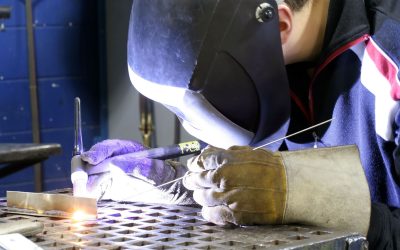
• Manual micro laser welding : requires precise, careful craftsmanship to join or repair parts, making it a strong fit for custom or one-off work such as mold revisions.
• CNC laser beam welding : offers the control and superior accuracy required for low to high volume production, which benefits manufacturers scaling output while maintaining consistency.
• Technical control : the spot size of the laser can be set from .005 inches to .100 inches, and the depth of penetration is proportional to the amount of power supplied but is also dependent on the location of the focal point.
Deciding between these two methods often comes down to volume, part geometry, and how tight the tolerance requirements are for the finished component.
Industries That Depend on Precision Laser Welding
Laser welding plays a role across several sectors where weld quality cannot be compromised. Micro laser welding produces highly precise and narrow welds for various industries, including general and industrial, medical device, oil and gas, and mold revision and repair.
Common applications include:
1. Medical device components – surgical instruments, implants, and diagnostic equipment often require welds that withstand strict quality and sterilization standards.
2. Injection mold tooling – repairs and revisions on molds and dies benefit from narrow, controlled welds that preserve surface detail.
3. Industrial and production parts – components across aerospace, automotive, and electronics sectors require unmatched accuracy, minimal heat distortion, and maximum reliability, with clean, precise welds even on the smallest components.
A peer-reviewed review published in 2025 noted that the goal of solid-state laser welding is to create strong, precise, and efficient welds between metal components, using a high-precision, sophisticated joining method. This underscores why laser-based processes continue to gain traction over older joining techniques in sectors where tolerance and material integrity are non-negotiable.
Frequently Asked Questions
What makes laser welding different from standard welding methods? Laser welding concentrates energy into a narrow beam, which limits heat spread and reduces distortion compared to broader-heat methods like MIG or standard arc welding.
Is laser welding suitable for small or delicate parts? Yes. The ability to control spot size and focal depth allows technicians to join fine wires and small components without damaging surrounding material.
When should a manufacturer choose CNC over manual laser welding? CNC laser welding is generally better for repeatable, higher-volume production runs, while manual welding suits custom repairs or low-volume, detail-intensive work.
Which industries use laser welding most often? Medical device manufacturing, mold tooling and repair, and general industrial production are among the most common users of precision laser welding services.
Laser welding continues to serve as a practical solution for manufacturers who need durable, precise metal joins without the distortion risks of older welding techniques. Businesses evaluating a provider should look closely at whether the service offers both manual and CNC capabilities, since project scale and part complexity often determine which method delivers the best outcome. For companies weighing their options, Micro Weld, Inc offers insight into how laser welding capabilities are applied across medical, industrial, and tooling applications.